
- News
- City News
- coimbatore News
- City ready for climate action projects
Trending
This story is from August 19, 2023
City ready for climate action projects
Tier-II cities in Tamil Nadu are yet to allocate budgets and implement climate action projects, reveals a report by the National Institute of Urban Affairs under the Union housing and urban affairs ministry and the International Council for Local Environmental Initiatives, South Asia.

Image used for representative purpose only
While Coimbatore, Trichy and Tirunelveli were among the 15 cities in India assessed for the climate resilience goals, Coimbatore topped the TN cities with three stars in the 'States of Cities: Towards Low Carbon and Resilient Pathways July 2023' report.

The ranking under the Climate Smart Cities Assessment Framework 2.0 was based on the adaptation and mitigation measures taken by the urban local body towards climate action.
The three-star status indicates that the city has institutional mechanisms in place or is in the process of developing climate action plans.
The report pegged Coimbatore's per capita greenhouse gas emission at 1.60 Tco2e, energy consumption at 10.48 giga joules and per capita electricity consumption at 1,088 Kilowatt hour (kWh). The findings are based on the 2020-21 financial year data.
As per the report, Coimbatore city has introduced power factor correction panels to reduce power loss at the water treatment plants and sewage water pumping stations.
At 33%, the residential sector is the highest energy consuming sector in Coimbatore. Industry is the highest greenhouse gas emitter, as it accounts for 33% of the total emission.
When it comes to the civic body operations, water supply accounts for the highest energy consumption at 43% and greenhouse gas emission at 51%.
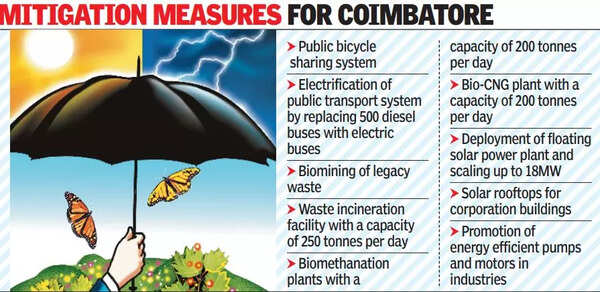
Explaining the measures taken towards climate action, Coimbatore corporation commissioner M Prathap said they had recently unveiled a project to develop Miyawaki forests at 120 open space reservation lands.
"We are now focusing on setting up green buildings. The knowledge and study centre to be opened here meets all the requirements for a green building. To improve the green cover, 40,000 trees will be planted at Vellalore dump yard after cleaning legacy waste. The civic body is already saving big on electricity, by switching to LED streetlights. To further save electricity, an automated system will be introduced to switch on and off the lights. We will implement more projects in the coming months towards climate resilience and better ratings," he said.
Tirunelveli and Trichy received two stars, which means that they have only initiated data analysis or established committees towards climate action.
Tirunelveli, which is the smallest city among the three, consumes less energy and electricity and emits less greenhouse gas. Its per capita greenhouse gas emission is 1.2 Tco2e, per capita energy consumption is 8.76 giga joules and per capita electricity consumption is 8.10kwh.
In Tirunelveli, the residential sector is the highest consumer of energy and the highest emitter of greenhouse gas at 46% and 51%, respectively.
Tirunelveli's open space improvement plan by planting more trees, and setting up biodiversity parks and urban forests has found a mention in the report.
Trichy's average per capita electricity consumption is 1,125kWh, which is the highest among the three TN cities. It is also higher than the average of 15 cities which is 1,025kWh.
In Trichy, transport accounts for 36% energy consumption, which is the highest among all sectors, whereas the highest of 33% greenhouse gas emission comes from the residential sector.
Among other cities, Ahmedabad, Rajkot, Vadodara and Pimpri-Chinchwad received four stars, while Nagpur, Shimla, Thane and Udaipur received three stars, and Kochi, Gwalior, Panaji and Siliguri received two stars.
End of Article
FOLLOW US ON SOCIAL MEDIA










Hot Picks
TOP TRENDING
Trending Stories
In City
Entire Website
- UPS vs NPS Calculator: Is A Switch From National Pension Scheme to Unified Pension Scheme Really A No-Brainer? Check Calculations, Benefits - Top Points
- Monster vs Monster: WWE announced massive match for this week's Monday Night Raw
- UPI transaction limit to change from September 16! Here are the new limits for various UPI payments
- File movement linked to weight of money: Nitin Gadkari
- Apple's biggest 'iPhone update' for year 2024, iOS 18, rollout starts today - September 16: India time and how to prepare your iPhone for iOS 18 download
- Arvind Kejriwal's resignation: Who will be next Delhi CM? Atishi seen as top choice
- UP medical aspirants converting religion to secure MBBS seats: A look at NEET UG admission criteria around minority reservation rules
- Protests against students wearing hijab in school play, principal forced to apologize for promoting religious harmony
- Pitru Paksha 2024 Date and Time: Know Significance of Shradh Paksha
- Andhra suspends 3 IPS officers for 'framing', arresting Mumbai actress
- 'Look at own record': India condemns remarks by Iran's Supreme Leader Khamenei
- Watch: BJP MLA falls on rly tracks while flagging off Vande Bharat train
- Cow vigilantes killing a Brahmin is the wake-up call India needed
- MHA to open Kendriya Police Kalyan Bhandars for civilians in Manipur
- Docs-Mamata meet ends but minutes of meeting still being finalised
- 2 attempts to 'kill' Trump in 2 months: How it may impact US polls
- Did doctors humiliate Mamata, or did she make it an ego issue?
- Apple's biggest 'iPhone update' for year 2024 rollout starts today
- 'No India vs Pakistan final': Pak fans rue defeat in ACT semis
- UPS vs NPS Calculator: Switch a no-brainer? Not really! Check top points

Popular Categories
Hot on the Web
Top Trends
Prince HarryWho is Ryan RouthUPI Transaction LimitArvind Kejriwal ResignationNEET UG Admission CriteriaKolkata Doctor Rape CaseUS Presidential ElectionsRohit SharmaSports Stars Turned Power CouplesIBPS RRB Clark PO ResultDonald TrumpCristiano RonaldoIndia vs Korea HighlightsBMW Accident Madhya PradeshUPS vs NPS CalculatorMiami Dolphins OwnerLive Cricket Score
Trending Topics
Living and entertainment
Latest News
Who was Illia 'Golem' Yefimchyk, the Belarusian bodybuilder who consumed 2.5 kg of meat and 108 sushi pieces daily before his death at 36?Vempalle Shareef's story is now a lesson for degree students in Andhra PradeshGovt launches programme to tackle glacial lake outburst flood threat in Himalayas, all 190 high-risk lakes to be monitoredWhen Shah Rukh Khan performed 'Kanyadaan' at Farah Khan's wedding- See PICSAstrological Influence on Zodiac Signs' Career ChoicesBike rally held to raise voter awareness in Jammu and Kashmir's Doda ahead of assembly electionsFalcons' Predictable Offense and Cousins' Prime-Time Woes Spell Trouble in PhiladelphiaFather-son duo Eugene and Dan Levy's dazzling entrance at the EmmysLiza Colon becomes 1st Latina to win Best Supporting Emmy Award'Oh no!': Hilarious goof-up leads to missed catch, leaves bowler in smile. WatchJr NTR on shooting under water scene for 35 days in 'Devara Part 1': It is an important sequence!Top NFL Superstars Who Are Vegan: Derrick Morgan, David Carter, Theo Riddick and moreKSCA Invitational: Arjun Tendulkar takes match haul of 9 wickets in big Goa CA XI winAbhishek Kumar shares selfies with Alia Bhatt; recalls the time when he worked as a crowd artist in ‘Humpty Sharma Ki Dulhaniya’Jessica Gunning wins her 1st Primetime Emmy for 'Baby Reindeer'Shocking! Man celebrates birthday by lying among massive PythonsSohum Shah says 'Tumbbad 2' will be different from 'Munjya' and 'Stree 2': 'They are not making dadi-nani ki kahaniyaan'Sathiyan set to partner Sreeja in mixed doubles
Copyright © 2024 Bennett, Coleman & Co. Ltd. All rights reserved. For reprint rights: Times Syndication Service